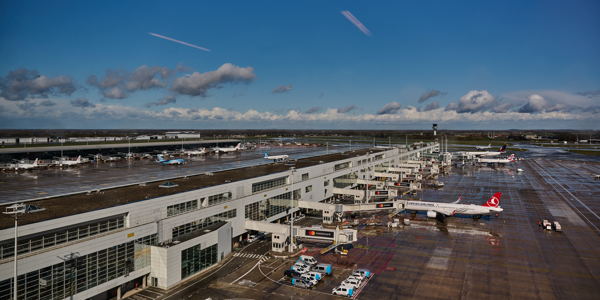
283,000 passengers passed through Brussels Airport in January, a decrease by 84%

283,164 passengers passed through Brussels Airport in January, which is a mere 16% of the number of passengers recorded in January 2020. The start of the year was marked by the end of the Christmas holidays in the beginning of the month and by the ban on non-essential travel at the end of the month. Air cargo traffic on the other hand continues the growth that started last summer with a significant 21% increase in volumes carried compared to the same period in 2020. The cargo division at Brussels Airport continues to play a significant role in shipping COVID-19 vaccines around the globe.
‘After a very difficult year 2020 with a mere 7.6 million passengers, Brussels Airport expects another few challenging months for the aviation sector in particular’, explains Arnaud Feist, CEO of Brussels Airport Company. ‘The ban on non-essential travel which came into force two weeks ago will impact the whole of February and will further drive down passenger numbers. We hope with all our heart to be able to relaunch non-essential travel, in all safety, during the Easter holidays and we are really hopeful for the summer. The low activity in passenger traffic stands in real contrast to the intensity of our cargo activities which grew by a strong 20% in January. Brussels Airport continues to play an important role in the transport of COVID vaccines thanks to our specialised equipment and partners.’
Passenger traffic: down by 84%
283,164 passengers passed through Brussels Airport in January, down 84% compared to January 2020. A quarter of our passengers were transfer passengers, thanks to the network of Brussels Airlines and its partner airlines between North America, Europe and Africa.
The first two weeks of the year, Brussels Airport recorded a decrease of ‘only’ 80%. To a large extent, this is explained by the higher number of passengers who returned to Belgium after a stay abroad, mainly for visiting relatives. As of the 27th of January, following new travel restrictions and, more particularly, the ban on non-essential travel imposed by the federal government, several airlines have further reduced the frequency of their flights. It should be noted that the number of flights to holiday destinations was already very limited as a result of travel advice previously issued by the authorities.
The majority of the flights carried out from Brussels Airport are for essential travel, both for professional and family reasons.
Numerous intercontinental flights have a low passenger load factor which is made up for by the growth in cargo traffic which uses passenger flights to meet the strong demand in cargo capacity.
Cargo: significant volumes and vaccine shipments
Just like these past few months, air cargo volumes have again recorded significant growth, up 21% on January 2020. Thanks to this result, Brussels Airport continues to do better than the average growth seen in Europa and worldwide which is negatively impacted by the strong decrease in the number of passenger flights operated by wide bodies.
In January, air cargo volumes in the full-freighter segment grew sharply by 73% compared to the same month in 2020. Integrator services too recorded strong growth compared to last year (+37%). These strong growth figures largely compensate for the limited volumes of belly cargo carried on passenger flights. And for once, trucked air cargo also records an increase (+10%), after several months of negative growth.
The total volume of goods handled by the logistics platform at Brussels Airport grew significantly (+ 18%) in January, totalling to 58,311 tonnes. The transport of COVID vaccines, which is sure to continue all through the year, has found in Brussels Airport a top-notch logistics hub, specialised in temperature-sensitive goods, particularly pharmaceuticals.
Imports from Asia and North America are recording strong growth compared to the same month last year. On the exports side, we find that the volumes towards Asia in particular are doing well. We also note a positive impact on air cargo volumes related to Brexit.
Flight movements
In January 2021, the number of flights decreased by 66% on January 2020 to reach 5,680 flights (against 16,885 flights last year). The number of passenger flights decreased by 78%.
Last January, the number of cargo flights grew by 41% compared to January 2020. This growth is recorded during the daytime, as the number of night flights did not increase.
During the month of January, the number of cargo flights operated by passenger aircraft continues to increase compared to the previous months. In doing so, the airlines provide additional cargo capacity to supplement full-freighter capacity.