Brussels Airport and TUI fly are testing the Taxibot for sustainable taxiing

During the next months, a Taxibot will be tested at Brussels Airport. Brussels Airport and TUI fly are conducting these tests as part of the Stargate program, a European Green Deal project for a greener aviation. The Taxibot is a semi-autonomous aircraft towing system that can significantly reduce environmental impact, as taxiing will happen using the Taxibot on biodiesel, instead of using the aircraft engines.
Since last week, a Taxibot is being tested at Brussels Airport, in cooperation with TUI fly. This initiative is part of the Stargate program, an ambitious project selected by the European Commission to test and develop solutions for more sustainable aviation. Brussels Airport is project leader and works together with a diverse consortium of 21 partners including three European airports and several airlines.
In close collaboration with TUI fly, Brussels Airport is the first Belgian airport to test the Taxibot for sustainable taxiing. This semi-robotic truck on biodiesel enables airplane taxiing without engines running.
"It is very important to look into innovative solutions to reduce the environmental impact of our airport operations. The Taxibot offers a new and interesting alternative for taxiing, so by testing the Taxibot at Brussels Airport, we do not only look into its operational use but also we get a clearer view on the benefits using it in our infrastructure. A great collaboration with TUI fly, as our home carriers are equally committed to continue working on greener operations." says Arnaud Feist, CEO of Brussels Airport.
Gunther Hofman, Managing Director TUI fly Western Region: "Since its creation, TUI fly Belgium has put sustainability at the heart of its flight operations. We are therefore proud, like all partners in Brussels Airport's Stargate project, to contribute to greener aviation. The use of the Taxibot is an important new step in this process. This innovative vehicle will allow us to tow aircraft while saving fuel and reducing CO2 emissions”.
A more sustainable alternative for taxiing
The Taxibot is a semi-robotic truck that can be controlled by the pilot. It is the only certified solution for sustainable taxiing and can do the taxiing of B737 and the A320 aircraft family. Instead of using the own engines of the aircraft for taxiing, it is the Taxibot on biodiesel that will be pulling the aircraft towards its destination. The pilot remains in full control during the procedure and controls the brakes, just as during normal taxiing. Taxiing happens at the same speed as normal taxiing, but the use of the Taxibot can strongly reduce jet fuel consumption, emissions (up to 85% less CO2, UFP, NOx, etc.) and the noise impact (up to 60% noise reduction) during taxiing.
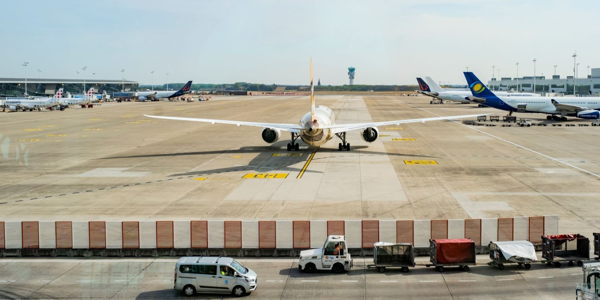
The aim is to test the truck on the taxiways at Brussels Airport, to assess the benefits in this specific operational context. Though taxi times at Brussels Airport are relatively short, a Taxibot should still have a positive impact on noise and emissions compared to taxiing on the aircraft’s engines. The tests have started on the 25 March, after the training of the pilots of TUI fly. The tests will run for three months to be able to assess the benefits of this taxiing alternative.
For more information on the Stargate program, please visit the Stargate website.

This project has received subsidies within the Horizon 2020 research and innovation programme of the European Union in the context of subsidy agreement GA101037053.