Hovering roof of Sky Hall gets new support structure
Nostalgia with contemporary comfort

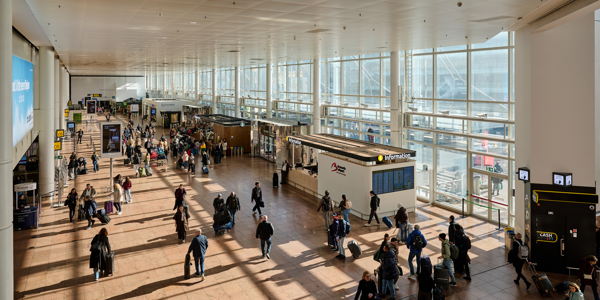
Brussels Airport has commenced renovation works on the roof of the Sky Hall, the former transit hall at the airport. It was a striking architectural choice in the fifties to have the roof rest on pillars in the middle of the space so that it seems to hover above the hall. The engineers of Brussels Airport Company have come up with their own out-of-the-box solution for the renovation so that the roof can continue to hover and the iconic look of the Sky Hall is retained.
As part of the renovation project of the Sky Hall, Brussels Airport has commenced the renovation of the roof, after previously having replaced the entire glass façade. The roof spans an area of 100 metres wide by 55 metres long and is at a height of 18 metres. The three-dimensional arched roof structure is completely in aluminium. The only support points for the roof are hinges on central support pillars and steel tension bars at the rear of the building.
Notwithstanding the ingenuity of the roof design from the fifties, the roof of the Sky Hall was no longer stable, nor did it meet the current fire safety standards and legislation. In a fire e.g. the aluminium roof would sag too quickly. If the Sky Hall was to be used again, the roof had to be renovated.
The Sky Hall houses millions of stories and brings back many nostalgic memories about a first trip or a family excursion to wave somebody off or to welcome them home. To honour the history and the stories, it is extremely important for Brussels Airport to retain that familiar look after the renovation of the Sky Hall, especially the iconic roof.
At the same time, the airport wants to adapt the former transit hall to the current needs and comfort standards, so that the hall can be made accessible again. Account must be taken here of the fact that the existing roof cannot carry any additional weight, and that the shell of the building must be insulated better and differently.
Three 53.5-ton trusses integrated into the roof structure
After various fruitless external studies, the engineers of Brussels Airport Company set to work themselves and came up with a solution of their own: a construction which will take over the roof function.
Three steel trusses, each 55 metres long and weighing 53.5 tons, are slid into the existing roof in three parts using a 700-ton crane. The trusses come between the four awnings of the aluminium roof. On the northern side façade, an additional truss weighing 20 tons will be put up.
The existing support pillars with hinges will be additionally reinforced with solid steel sheets to bear the additional weight. New tension bars will be placed between the existing one.
The preparations for the work on the roof have taken 3 years. The correct calculations had to be made and the appropriate permits obtained to be able to install the necessary building material at the airport. Brussels Airport has invested 23 million euros in the renovation of the building.
60 years ago
In the fifties, our country took the strategic decision to build a new airport infrastructure for the economic development of our country, in particular, to handle the expected flow of visitors to the World Exhibition, Expo 58. The heart of this new infrastructure was the transit hall, now also known as the Sky Hall.
The architects Brunfaut, Bontinck and Moutschen designed the hall as an open and light space, allowing travellers and visitors a fine view of the activities at the airport. The interior was finished with warm materials such as wenge wood as wall covering or yellow quartzite for the floor.
During the further development of the airport, the buildings were redesigned and/or extended. When a new passenger terminal was opened in the nineties, the transit hall was no longer used.