Brussels Airport and Safran Aero Boosters test device to improve air quality on and around the tarmac
Previous air measurements show promising initial results

Starting on 22 June, Brussels Airport and Safran Aero Boosters will test a large mobile air filter in an area next to the tarmac that removes fine and ultrafine particles from the air. The device is a first mobile prototype that will be tested in practice over the next three months. It was developed by Safran Aero Boosters with the support of the Walloon Region. The initial test period earlier this year has already produced positive results. During the second test period, which runs until the end of September, further research will be carried out into the concrete impact of the filter and its future potential.
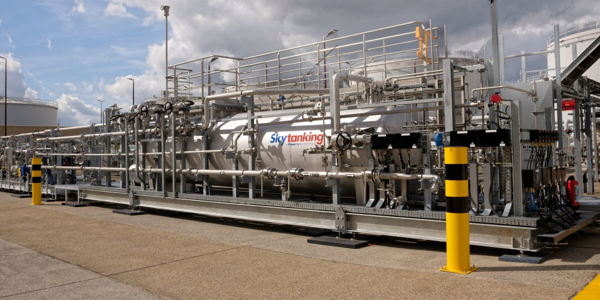
The second test phase of a remarkable and innovative project will start at Brussels Airport next week. A mobile air filter, in a container around twelve metres long, has been installed in an area next to the tarmac. This device, developed by Safran Aero Boosters, draws in ambient air and removes fine and ultrafine particles through an advanced industrial filtration system. Brussels Airport is the first airport in the world to test this type of air filter in a fully operational environment.
“As an airport, we are happy to contribute to innovative solutions with a positive impact on the local living environment. The pilot project with the mobile air filter is a great example of how, thanks to innovation, we can improve local air quality. According to the initial results, it is a promising technology that can make a difference for our staff and local residents,” says Arnaud Feist, CEO of Brussels Airport.
“Air quality management is at the heart of Safran Aero Boosters’ concerns, thanks to the expertise we have developed through our engine test benches, where we learned how to control airflows, particle treatment, and the monitoring of fine particulate matter. This prototype at Brussels Airport illustrates our ability to adapt our industrial and innovative technologies beyond their usual environments to address real operational challenges. I would like to thank Brussels Airport for an exemplary, swift, and efficient collaboration, as well as the Walloon Region for its decisive support for innovation,” says François Lepot, CEO of Safran Aero Boosters.
In concrete terms, for several hours between 8 a.m. and 8 p.m., the installation draws in air via a powerful fan at the front of the device, after which it passes through a filtration system that captures the fine and ultrafine particles. The purified air is then blown out at the rear of the device to mix again with the ambient air.
Positive results after initial air measurements
A first test phase with the air filter on the tarmac, directly in front of Pier A, had already taken place from December 2025 to March 2026. For this, Safran Aero Boosters worked together with various companies and research centres, including KMA Filter, the University of Liège (ULiège), the von Karman Institute, and GD Tech. To investigate the impact of the device during that test period, the Scientific Institute of Public Service (ISSeP) and the Flemish Institute for Technological Research (VITO) carried out various air quality measurements in the immediate vicinity of the filter. These initial results are already positive. The measurements are part of Brussels Airport’s European Stargate project, a Green Deal programme for more sustainable aviation.
After this second test phase, an analysis will be made of the extent to which the technology can be further deployed in the future at airports or other operational environments to improve local air quality.
This project has received funding from the Walloon Region and from the European Union’s Horizon 2020 research and innovation programme under grant agreement GA101037053.