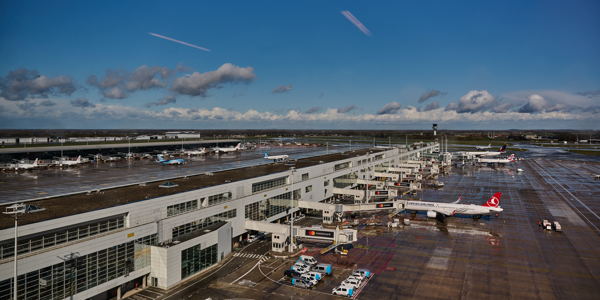
Brussels Airport and skeyes work together on a new landing procedure ​ ​ that can reduce environmental footprint of aviation

Brussels Airport and skeyes are investing together in research to develop new landing procedures that can improve the local environmental quality. The research that will be conducted by skeyes and Brussels Airport, with the support of Eurocontrol, is one of the components of the HERON project, led by Airbus. This project will analyse whether landings with steeper descent gradients have an advantage in terms of reducing the local noise impact, as well as CO2 emissions and fuel consumption.

skeyes and Brussels Airport have been involved for years in projects of the SESAR programme (Single European Sky ATM Research), the technological pillar of the Single European Sky. The SESAR programme aims to improve airspace management by modernising and harmonising Air Traffic Management technologies and systems. In this context,they both joined the "Highly Efficient Green Operations (HERON)" project.

HERON is led by Airbus and aims to carry out a series of ambitious developments and tests to reduce noise, flight delays, fuel consumption and CO2 emissions from air transport by proposing reduction measures, including more efficient flight operations. HERON includes 26 partners from 11 countries and will be supported by 6 airlines, 8 Air Navigation Service providers and 5 airports from all across Europe.

skeyes and Brussels Airport Company will contribute to the project by validating operational flight demonstrations of green approaches by introducing "Increased Second Glide Slopes (ISGS)" on two runways. ​ (Approaches at a descent angle of 3.2 - 3.5 degrees instead of 3.0 degrees, see figure below.) Increased Second Glide Slopes (ISGS) is an operational solution validated in the SESAR programme and aims to provide benefits in terms of noise impact and, to a lesser extent, fuel consumption. This will be the first time it will be tested in a fully operational environment.

skeyes and Brussels Airport, as well as TUI fly, DHL and Brussels airlines, who have expressed their explicit support to the project, met for the first time at skeyes yesterday for the kick-off of the project and to define the schedule for the real-life demonstrations at Brussels Airport. These demonstrations will take place in 2024.
Share

Latest stories

Website preview
Brussels Airport receives environmental permit for first phase of Hub 3.0: an important step towards the airport of the future
Brussels Airport has received an environmental permit for the first phase of Hub 3.0, a large-scale project that will prepare the airport infrastructure for the future. This permit allows Brussels Airport to officially start work on the expansion of the arrival and departure hall, the new intermodal hub, the construction of a new hotel and office building, and the creation of the green boulevard and park.
pressroom.brusselsairport.be
Website preview
Brussels Airport expects over 1 million passengers during the Christmas break
Brussels Airport expects more than 1 million passengers during the Christmas holidays. With nearly 1,060,000 passengers expected to depart and arrive (almost 3% more than last year), this is a new record for this holiday season. At the start of the holidays, on Friday 19 December, nearly 70,000 passengers are expected. They will be able to enjoy a unique Christmas concert on that day by the ‘Scaletta Choir’, the children's and youth choir of 'Scala'.
pressroom.brusselsairport.be
Website preview

Get updates in your mailbox

By clicking "Subscribe" I confirm I have read and agree to the Privacy Policy.

About Brussels Airport

Brussels Airport is one of the most important airports in Europe. In 2024, Brussels Airport welcomed 23.6 million passengers and transported 733,000 tonnes of cargo through the airport. Brussels Airport caters for the specific needs of business travellers and holidaymakers alike, on both intra-European and long haul flights. In 2025, the airport offers direct connections between Belgium and 210 destinations worldwide, with flights operated by 80 airlines.   

The airport also offers a leading cargo platform, specialised in the transport of pharmaceutical products, perishable goods, e-commerce and live animals. Brussels Airport is the most important pharmaceutical hub in Europe with the largest area of temperature-controlled warehouses.  

With its SHIFT 2027 strategy, launched in 2022, Brussels Airport Company intends to strengthen its position as a major European hub, accelerate its ambitious sustainability goals, e.g. through the European Green Deal project Stargate, and continue to diversify its activities by focusing on innovation and cooperation.

Brussels Airport is the second most important economic engine in Belgium, good for 64,000 direct and indirect jobs and is owned and operated by Brussels Airport Company. The shareholders are a consortium of private investors (75%) and the Belgian State (25%).Follow Brussels Airport on TwitterLinkedinInstagramTikTok and Facebook.  

Contact

www.brusselsairport.be